
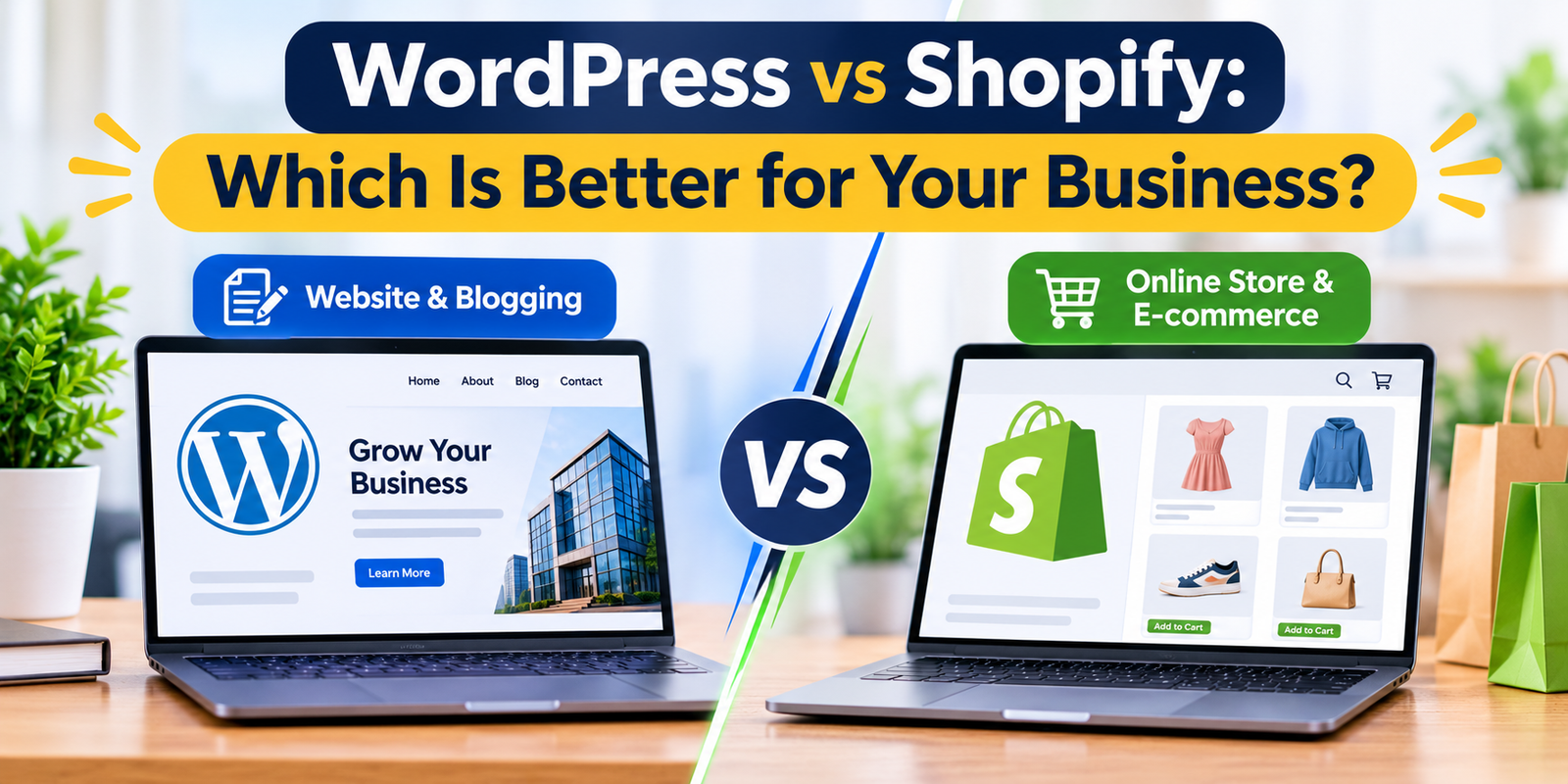
Choosing the right platform for your website is an important decision for any business. Whether you want to build a professional business website, launch an online store, sell products, or grow your brand online, selecting the right platform can make a significant difference.
Two popular options are WordPress and Shopify. Both platforms help businesses establish an online presence, but they offer different features, customization options, pricing structures, and website management experiences.
In this guide, we will compare WordPress vs Shopify based on features, pricing, SEO, customization, ease of use, and eCommerce capabilities to help you choose the right platform for your business.
What Is WordPress?
WordPress is a popular content management system (CMS) that allows users to create and manage websites. It is suitable for business websites, blogs, portfolios, service-based websites, and online stores.
With WordPress.org, you can choose your hosting provider, customize your website using themes, and extend its functionality through plugins. You can also use WooCommerce to transform your WordPress website into a fully functional online store.
Key Features of WordPress
- Flexible customization: Customize website layouts, designs, and functionality according to your business requirements.
- SEO capabilities: Optimize page titles, meta descriptions, URLs, headings, and other SEO elements.
- Content management: Publish blogs, articles, landing pages, and other website content.
- eCommerce functionality: Sell physical products, digital downloads, and services using WooCommerce.
- Plugin ecosystem: Add contact forms, analytics, booking systems, and marketing integrations.
- Greater control: Choose your hosting provider and manage your website configuration.
WordPress is an excellent option for businesses that need flexibility, content marketing capabilities, and room to grow.
What Is Shopify?
Shopify is a hosted eCommerce platform designed to help businesses create and manage online stores. It provides tools to list products, manage orders, accept payments through supported payment providers, and sell online.
Unlike self-hosted WordPress, Shopify includes hosting as part of its platform service. This makes it easier for business owners to launch and operate an online store without managing a separate hosting environment.
Key Features of Shopify
- Easy store setup: Build an online store using themes and a guided dashboard.
- Product management: Organize products, collections, prices, inventory, and product variants.
- Order management: Track orders, payments, and fulfillment workflows.
- eCommerce integrations: Connect supported payment gateways, shipping services, and marketing tools.
- Responsive themes: Create shopping experiences for mobile, tablet, and desktop users.
- App integrations: Extend store functionality through compatible apps.
Shopify is particularly suitable for businesses that want to focus on selling products and managing store operations.
WordPress vs Shopify: Key Differences
Understanding the differences between these platforms can help you make an informed decision.
| Feature | WordPress | Shopify |
|---|---|---|
| Best for | Business websites, blogs, and online stores | Online stores and eCommerce brands |
| Ease of use | Requires initial setup and learning | Generally easier for store setup |
| Hosting | Usually arranged separately | Included in the platform service |
| Customization | Extensive themes, plugins, and code access | Themes, apps, and supported customization |
| SEO | Flexible SEO controls and plugins | Built-in SEO features |
| Blogging | Powerful content publishing capabilities | Blogging tools for store content |
| eCommerce | Available through WooCommerce | Core eCommerce features included |
| Maintenance | Requires appropriate updates and maintenance | Much of the infrastructure is managed |
| Costs | Hosting, domain, plugins, and maintenance may apply | Subscription, domain, apps, and payment-related fees may apply |
The better option depends on your business model, technical requirements, budget, and future growth plans.
1. Ease of Use: Which Platform Is Easier?
Shopify is generally easier for beginners who want to launch an online store quickly. Its dashboard brings product management, orders, themes, and essential store settings together in one place.
WordPress offers more flexibility but may require additional setup. You need to arrange hosting, configure your theme, manage plugins, and maintain your website. WooCommerce also requires configuration before you can start selling.
Businesses that need a straightforward store-management experience may prefer Shopify. Businesses that want control over their website structure and functionality may prefer WordPress.
Winner: Shopify for beginners focused on eCommerce; WordPress for users who want greater control over their website.
2. Pricing: Which Platform Is More Affordable?
The total cost of a website depends on its features, traffic, design requirements, and maintenance needs.
WordPress software is available free of charge, but you generally need to pay for hosting and a domain. Premium themes, plugins, development, backups, and maintenance can increase the overall cost.
Shopify uses subscription-based pricing. Additional expenses may include premium themes, paid apps, domain registration, and payment-related fees, depending on your setup and plan.
Neither platform is automatically cheaper for every business. Compare the total cost of ownership rather than looking only at the starting price.
Winner: WordPress may be more economical for some websites with modest requirements. Shopify can provide greater convenience for businesses focused on selling online.
3. SEO: WordPress vs Shopify
Search engine optimization (SEO) helps your website appear in relevant search results and attract potential customers through organic traffic.
WordPress provides extensive SEO flexibility. You can optimize page titles, meta descriptions, headings, internal links, URLs, and structured data using plugins and appropriate website configuration.
Shopify also provides essential SEO features, including editable page titles and meta descriptions, customizable URL handles in supported areas, canonical tags, and automatic XML sitemap generation.
Both platforms can rank well in search engines. Rankings depend on content quality, search intent, technical SEO, website performance, competition, and backlinks.
If your strategy relies heavily on blogging, informational content, and landing pages, WordPress provides a flexible content-management environment.
Explore our Search Engine Optimization (SEO) Services to learn how SEO can help improve your website’s organic visibility.
Winner: WordPress for extensive content publishing and SEO customization. Shopify is also a capable choice for product-focused SEO and eCommerce growth.
4. Customization and Design
WordPress provides extensive design flexibility through themes, page builders, plugins, and custom code. You can build landing pages, service pages, blogs, portfolios, and advanced website experiences.
Shopify offers customizable themes, a theme editor, apps, and code-level customization options depending on the theme and setup. It is designed around online stores, including product pages, collections, and shopping workflows.
If your business needs a highly customized informational website, WordPress may be the better fit. If you need a professional online store with product and checkout functionality, Shopify provides a more focused starting point.
For a professional website tailored to your business goals, explore our Website Development Services.
Winner: WordPress for broad website customization; Shopify for streamlined eCommerce design and store management.
5. eCommerce: Which Platform Is Better for Online Stores?
Shopify is purpose-built for eCommerce. It provides a central place to manage products, inventory, orders, and supported payment and shipping integrations. It is particularly convenient for brands selling clothing, accessories, beauty products, home decor, and other physical goods.
WordPress can also power a complete online store through WooCommerce. It supports product catalogs, shipping settings, tax configuration, payment integrations, and many additional extensions. However, setup and maintenance requirements depend on your hosting, plugins, and configuration.
For a store that needs extensive customization, WordPress with WooCommerce offers flexibility. For a business that wants an integrated store-management experience, Shopify is often easier to operate.
Winner: Shopify for ease of eCommerce management; WordPress with WooCommerce for businesses that prioritize flexibility and control.
6. Security and Maintenance
With WordPress, security depends partly on your hosting environment, software updates, plugin quality, access controls, backups, and maintenance practices. Website owners need to manage these responsibilities or work with a reliable service provider.
Shopify manages much of the underlying hosting infrastructure and platform maintenance. Store owners still need to protect their accounts, manage staff permissions, review third-party apps, and follow secure operating practices.
Both platforms can support secure websites when configured and managed properly.
Winner: Shopify for reduced hosting and infrastructure maintenance. WordPress is suitable for businesses that want greater technical control and can manage ongoing maintenance.
7. Which Platform Is Better for Different Business Types?
Your ideal platform depends on what you want your website to achieve.
Choose WordPress If You Want To
- Build a business website for your services.
- Publish SEO-focused blogs and educational content.
- Generate leads through landing pages and contact forms.
- Create a portfolio or company website.
- Customize website functionality using plugins and code.
- Build an online store using WooCommerce.
Choose Shopify If You Want To
- Launch an online store quickly.
- Sell physical products through a product catalog.
- Manage orders, inventory, and collections from one dashboard.
- Connect supported shipping, payment, and marketing integrations.
- Expand your eCommerce operations as your brand grows.
- Spend less time managing hosting infrastructure.
WordPress vs Shopify: Pros and Cons
WordPress Pros
- Extensive customization options.
- Powerful blogging and content management features.
- Flexible SEO configuration.
- A large ecosystem of themes and plugins.
- Freedom to choose hosting and technology.
WordPress Cons
- Requires ongoing updates and maintenance.
- Hosting and plugin quality affect performance and security.
- Advanced features may require technical expertise.
- Costs can increase with premium tools and custom development.
Shopify Pros
- Easy online store setup.
- Hosting included in the platform service.
- Integrated product and order management.
- A dedicated eCommerce ecosystem.
- Less responsibility for underlying infrastructure maintenance.
Shopify Cons
- Subscription costs and additional app expenses.
- Some features depend on third-party apps or paid plans.
- Customization may require platform-specific development.
- Migrating away may require additional work to transfer store data and functionality.
Frequently Asked Questions
1. Is WordPress better than Shopify?
WordPress is a strong choice for business websites, blogs, content marketing, and highly customized projects. Shopify is often more convenient for businesses that primarily want to sell products online.
2. Which platform is better for SEO?
Both WordPress and Shopify support SEO. WordPress offers extensive content-management flexibility, while Shopify provides built-in SEO features for online stores. Results depend on implementation, content quality, competition, and technical performance.
3. Can WordPress be used for eCommerce?
Yes. You can use WooCommerce to add product management, shopping carts, checkout functionality, payment integrations, and shipping options to a WordPress website.
4. Is Shopify suitable for small businesses?
Yes. Shopify can be suitable for small businesses that want to launch an online store without managing a separate hosting environment. The right plan depends on the store’s needs and budget.
5. Can I migrate from Shopify to WordPress?
Yes. Products, customer records, orders, and other data may be migrated using exports and migration tools, subject to platform limitations. Some design elements, apps, and custom functionality may need to be rebuilt.
Final Verdict: WordPress vs Shopify — Which Is Better?
WordPress and Shopify are both powerful platforms, but they serve different priorities.
If you need a flexible business website, a blog-driven SEO strategy, lead generation pages, or extensive customization, WordPress is an excellent choice. With WooCommerce, it can also support a feature-rich online store.
If your main goal is to sell products online and manage orders, inventory, and store operations through a streamlined platform, Shopify is often the more convenient option.
Before choosing, consider your budget, technical resources, marketing strategy, and long-term business goals.
At Growth With Tech, we help businesses build professional websites and strengthen their online presence through website development, SEO, and digital marketing solutions.
Explore our Digital Marketing Services to discover ways to reach your target audience and grow your business online.
Need help choosing the right platform for your business?
Contact Growth With Tech to discuss your website requirements and find a solution that fits your business goals.